1. What Is AI Search Visibility?
AI search visibility refers to how often and how prominently your business appears in responses generated by AI-powered search platforms, such as Google AI Overviews, ChatGPT, Perplexity, Gemini, and Copilot, not just in traditional ranked SERPs. It measures whether AI systems mention, cite or use your content when answering real user queries instead of showing links alone.
This concept expands beyond classic SEO. Traditional SEO optimises for keyword rankings in lists; AI search visibility means your brand is part of the conversational answer itself.
For businesses in 2026, this is crucial because users increasingly rely on AI assistants to deliver concise, decision-ready answers. If AI doesn’t reference your brand in that process, you may lose authority, leads, and revenue, even if your website ranks well in traditional search.
This blog will explain how the shift to AI search affects your visibility, the signals AI systems value, and what steps your business can take to win both traditional SEO and AI search visibility simultaneously.
2. The Shift from Google-Only Search to AI-Powered Search
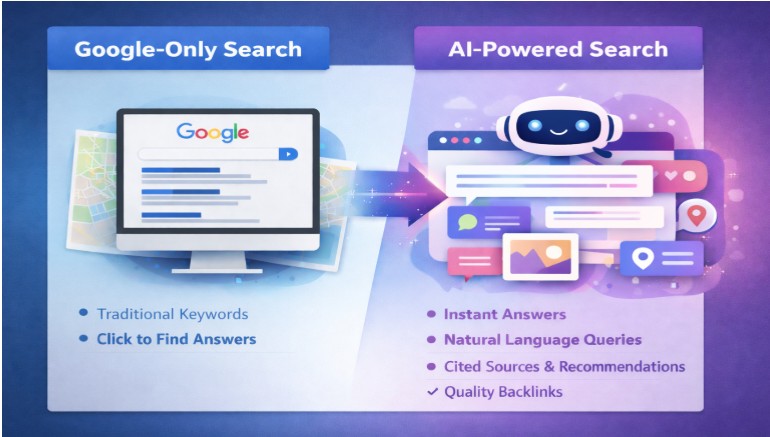
The search landscape has transformed from a focus on list-based SERP rankings to AI-first discovery and answers. AI search tools generate real-time responses, condensing information from multiple sources into a single output, eliminating the need for a click-through in many cases.
This shift means that:
- Users increasingly ask natural-language queries (e.g., “What is the best marketing strategy for UK SMEs?”).
- AI systems generate direct answers rather than presenting blue links.
- Your visibility is measured by citations and context inclusion within those answers.
Consequently, optimisation now must consider AI understanding and representation, not just keyword rankings.
3. Why Is AI Important for Businesses?
AI has reshaped information retrieval and buyer behaviour:
1. Search behaviour is changing
Users trust and use AI platforms for decision-making queries. According to recent data, ~89% of B2B buyers use AI platforms like ChatGPT for research before purchasing.
2. SEO visibility is no longer enough
Survey data shows nearly 90% of businesses fear losing visibility in the AI era, and most have begun investing in AI SEO strategies.
3. Brand presence becomes strategic
AI answers influence trust, authority, and user intent. Even if the user doesn’t click on your website, being mentioned in the answer impacts brand perception and downstream conversions.
AI-Powered Digital Marketing Agency in Scotland
Building Growth Systems That Drive Sales
We help B2B businesses in Glasgow, Edinburgh, Aberdeen and across Scotland generate more leads, close more deals, and build a scalable Growth Engine — powered by AI, designed by experts.

4. What Signals Matter For AI Search Visibility
Traditional SEO still matters. AI systems do not work in isolation. They rely heavily on the same crawlable, indexable web that search engines use. But AI search visibility adds extra layers. It is not just about ranking. It is about being selected, summarised, and cited.
Below are the core signal groups that influence whether AI tools include your business in their answers.
4.1 Retrievability: Can AI Easily Find and Understand Your Content?
If AI systems cannot clearly extract meaning from your page, you will not appear in AI answers.
Key retrievability factors:
- Clear heading structure (H1, H2, H3 used logically)
- One main topic per page
- Short, direct paragraphs
- Lists and step-by-step sections
- Question-and-answer formatting
AI systems scan content looking for:
- Definitions
- Explanations
- Steps
- Comparisons
- Recommendations
If your page buries answers in long blocks of text, AI struggles to extract them.
Good example structure:
“What is AI search visibility?”
- → Direct answer in first 2–3 lines
- → Expanded explanation below
- → Example
- → Use case
Bad structure:
- No headings
- Multiple topics mixed
- Long paragraphs
- No clear answers
Retrievability is the foundation. If this fails, nothing else matters.
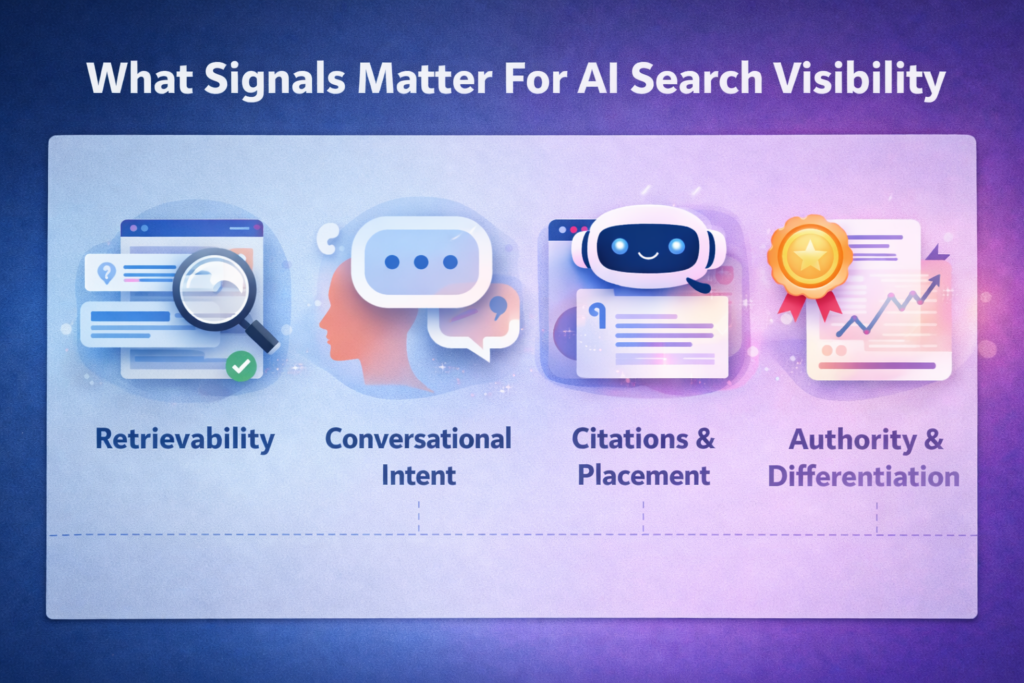
4.2 Alignment With Conversational Intent
AI search is built around how people talk, not how marketers used to write.
Users now ask:
- “What is AI SEO?”
- “How do I get visible in AI search?”
- “Is AI search replacing Google?”
- “What does AI use to rank businesses?”
They do not search:
“AI SEO strategy UK 2026 business marketing”
AI favours content that:
- Uses natural language
- Mirrors real questions
- Answers in plain English
- Avoids keyword stuffing
To align with conversational intent:
- Write headings as questions
- Answer directly underneath
- Use everyday language
- Explain like you are talking to a client
Example:
Heading:
How does AI choose which businesses to mention?
Answer:
AI chooses businesses based on clarity, authority, trust signals, and how well your content matches the question being asked.
This style helps both AEO and AI comprehension.
4.3 Citations, Impressions and Placement
In AI search, visibility is not just about clicks.
It includes:
- Being mentioned in AI answers
- Being cited as a source
- Appearing early in the response
- Being used in summaries
Some AI platforms show sources. Others do not. But even without visible links, your brand can still influence the answer.
Important visibility signals:
- How often your brand appears in AI answers
- Where in the answer you appear
- Whether your site is used as a reference source
- Whether your wording shapes the final answer
This means success looks like:
- People see your brand mentioned
- Your phrasing appears in answers
- Your ideas shape how topics are explained
Even without clicks, this builds:
- Brand authority
- Recognition
- Trust
AI visibility is partly brand marketing, not just traffic.
4.4 Authority and Differentiation
AI does not need generic content. It can generate that itself.
It looks for:
- Original insight
- Practical experience
- Unique frameworks
- Case-based explanations
- Clear expertise
Signals that build authority:
- Detailed service pages
- Real examples
- Named experts
- Clear positioning
- Consistent topics over time
Weak authority signals:
- Thin content
- Generic rewrites
- No point of view
- No experience shown
If your page sounds like it could be written by anyone, AI has no reason to prioritise it.
To stand out:
- Share how you do things
- Explain your process
- Show your thinking
- Use your brand voice
AI rewards clarity and originality.
4.5 Location Relevance
AI looks for:
- City and region mentions
- Service area clarity
- Location pages
- Consistent NAP data
You should have:
- Dedicated location pages
- Clear service areas listed
- City names in headings where relevant
- Local examples and case studies
Use:
“We help UK and regional businesses improve AI search visibility, including brands in Glasgow, London, Manchester and across the UK.”
What We Do
You’ll always know where your money is going and what you’re getting back. We’re Chartered Institute of Marketing trained. We bring structure, focus, and experience to every project.
SEO & Content Marketing
Technical fixes, on-page optimisation, AI-assisted articles, internal links
Paid Media & PPC
Google, Meta, LinkedIn. Precision targeting, smart bidding, clear ROAS tracking.
Email & CRM Automation
Lifecycle flows, segmentation, CRM clean-up, revenue dashboards.
Web Design & Development
Fast, mobile-first sites on WordPress or custom stacks. SEO and CRO baked in.
Analytics, CRO & Lead Gen
GA4, Looker Studio dashboards, heatmaps, AI lead-scoring, outreach campaigns
Branding & Creative
Logos, guidelines, social assets—all matched to your audience.
4.6 Google Business Profile and Local Entities
Even though AI is not Google, it still uses web signals influenced by:
- Google Business Profile data
- Reviews
- Business categories
- Photos and updates
Strong signals include:
- Completed profile
- Correct categories
- Regular updates
- Active reviews
- Real photos
AI systems use this data to confirm:
- You are a real business
You serve specific areas
You match certain services
4.7 Reviews and Trust Signals
AI prefers sources that show trust.
Trust signals include:
- Reviews
- Testimonials
- Case studies
- Media mentions
- Awards or certifications
For local visibility:
- Encourage Google reviews
- Mention locations in testimonials
- Include client locations where possible
Example:
“Marketing Mavens helped our Glasgow-based business improve our AI search visibility within three months.”
This reinforces both authority and location.
5. The Visibility Gap
5.1 How Businesses Lose Traffic Without Knowing
Many brands invest in SEO but remain invisible to AI search because:
- Their content doesn’t match conversational intents.
- Pages lack clear structure or schema.
- AI systems can’t reliably extract authoritative answers from them.
This means even well-ranked pages might never appear in AI outputs, reducing organic visibility and brand influence, creating the AI visibility gap.
5.2 What “Invisible” Looks Like in AI Search Results
Invisible brands are those:
- Not cited in AI answers.
- Not present when users ask industry questions.
- Overlooked by assistants in favour of competitors.
A business might own Page 1 of traditional search but get zero mentions when users query a question directly in ChatGPT or Gemini.
6. What Is AI Search and How Does It Work?
AI search uses large language models (LLMs) coupled with retrieval systems to find, summarise, and generate responses drawn from multiple sources.

When a user asks:
“What is AI SEO and why does it matter?”
The system:
- Interprets intent and semantics.
- Retrieves relevant information from indexed web pages.
- Synthesises a concise answer.
- May include citations or context from trusted sources.
You want your content to be part of this synthesis so that the AI references your brand as a source.
7. What Are the 10 Principles of AI Search Visibility?
While there’s no universally accepted single list, best practices based on industry research include:
- Understand user intent
- Provide precise direct answers
- Structure content clearly
- Use natural language
- Include semantic key terms
- Build topical authority
- Enable technical retrievability
- Provide entity clarity
- Use schema markup
- Monitor AI mentions
These principles align with both SEO and AEO (Answer Engine Optimization) strategies and ensure your content answers the right questions in the right context for AI systems to cite.
8. How Tools Like ChatGPT, Gemini, Copilot and Perplexity Find Answers
Each tool has its own stack, but you can think of them as following the same three-stage flow:
- Retrieval: find relevant sources
- Synthesis: write the answer
- Citations and trust: decide what to reference and how strongly
The differences sit in where they retrieve from, how they “ground” answers, and how citations work.
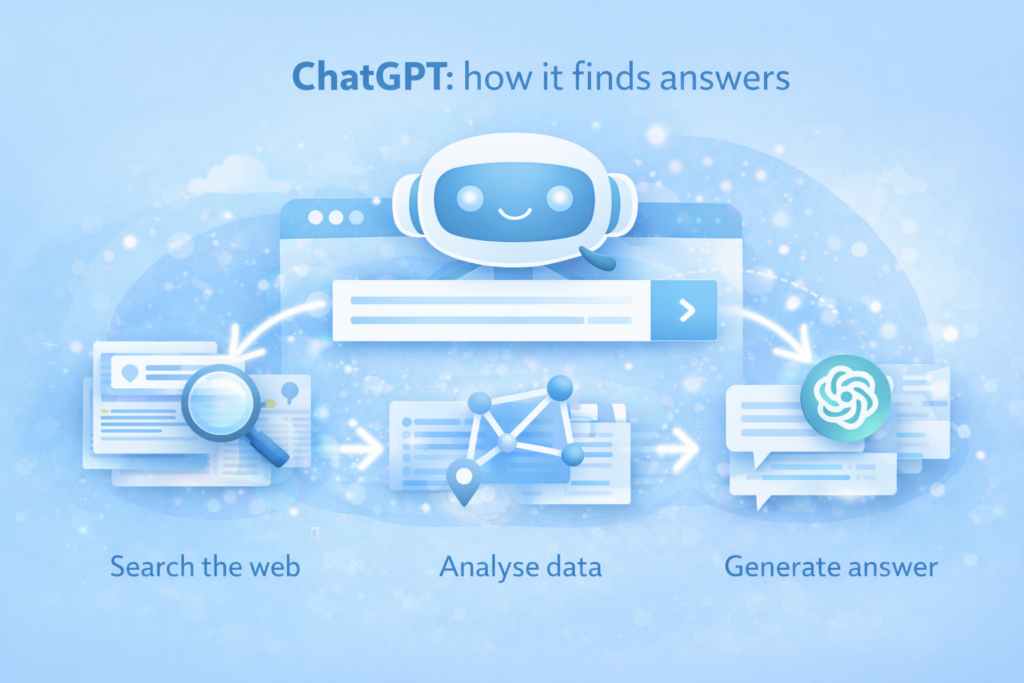
8.1 ChatGPT: how it finds answers
ChatGPT can answer in two broad modes:
Mode A: no live retrieval
- It responds from its trained knowledge and the conversation context.
- No web lookup happens.
- You do not get real-time accuracy.
This mode is useful for stable topics, but it is not what drives “AI search visibility”.
Mode B: retrieval and browsing
When browsing or search is enabled, ChatGPT uses retrieval methods to pull in external sources and then writes an answer grounded in them.
What we can confirm:
- Modern AI systems use Retrieval-Augmented Generation (RAG) to combine retrieval with text generation. RAG is a known approach where the model retrieves documents first, then generates output based on them.
- In practice, “how ChatGPT finds and cites content” varies by product configuration. Some third-party analyses state it primarily uses Bing as a web provider when it searches. I cannot confirm provider details in every environment because OpenAI can change this, and the sources here are not official OpenAI documentation.
What this means for your content:
- ChatGPT is more likely to use pages that are easy to extract answers from:
- question headings
- direct answers
- clear structure
- If your page includes strong definitions and step-by-step sections, it becomes “retrieval-friendly”.
How to write for ChatGPT visibility:
- Put the answer in the first 1–3 lines under each question heading.
- Use short bullet lists for steps and criteria.
- Include “proof” blocks: stats, examples, named processes, and references to recognised sources.
8.2 Gemini: how it finds answers
Gemini has a clear concept of “grounding” in Google Search.
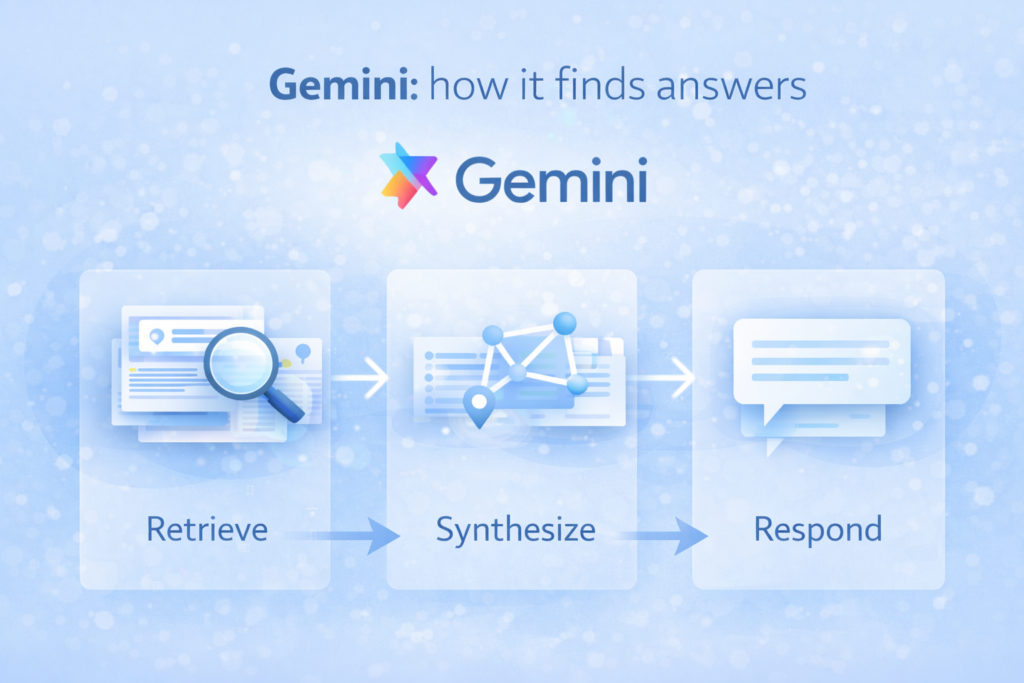
What we can confirm from Google’s own documentation:
- Gemini models can be grounded with Google Search to improve factual accuracy and to provide citations.
- Gemini “Deep Research” is designed to break down tasks, explore sources across the web, and synthesise results.
What this means:
- Gemini is tightly linked to Google’s search ecosystem when grounding is used.
- Your content needs to be accessible to Google’s crawlers and strong in classic SEO foundations, because that is the surface Gemini can pull from.
How to write for Gemini visibility:
- Write sections that match search intent patterns:
- What is
- Why it matters
- How to do it
- Examples
- Common mistakes
- Use schema where appropriate (FAQ, organisation, local business).
- Publish supporting pages that build topical authority, not one isolated blog.
Local angle:
- If your brand is UK-based and you want local visibility, Gemini grounding benefits from:
- location pages
- consistent NAP details
- strong Google Business Profile signals
These are classic local SEO inputs that feed Google’s understanding of your business, which then supports AI answers built on Google surfaces.
8.3 Copilot: how it finds answers
“Copilot” is used across multiple Microsoft experiences, but the public direction is consistent: it uses Bing-grounded web retrieval for many search-style experiences.
What we can confirm from Microsoft:
- “Copilot Search in Bing” provides summarised answers with cited sources.
- Microsoft documentation for Copilot tooling states that web search grounding uses Bing Search and pulls from public sites indexed by Bing.
What this means:
- If you only optimise for Google, you can still miss visibility in Microsoft’s ecosystem.
- Bing visibility matters again because it can influence whether Copilot cites you.
How to write for Copilot visibility:
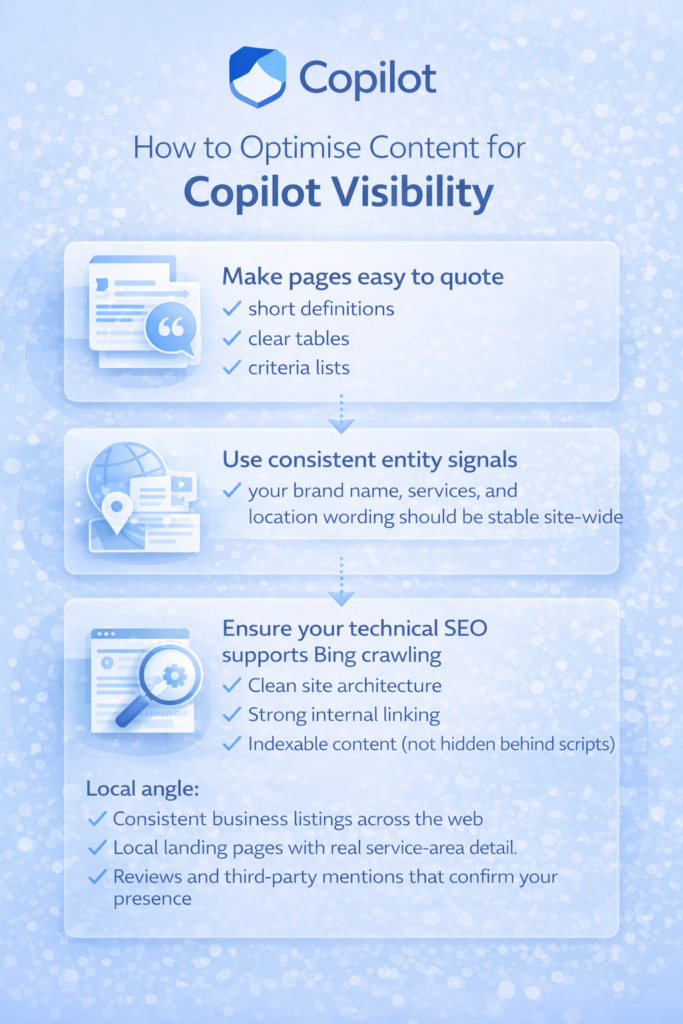
- Make pages easy to quote:
- short definitions
- clear tables
- criteria lists
- Use consistent entity signals:
- your brand name, services, and location wording should be stable site-wide
- your brand name, services, and location wording should be stable site-wide
- Ensure your technical SEO supports Bing crawling:
- Clean site architecture
- Strong internal linking
- Indexable content (not hidden behind scripts)
Local angle:
- For local discovery, Copilot’s Bing-grounded layer benefits from:
- Consistent business listings across the web
- Local landing pages with real service-area detail
- Reviews and third-party mentions that confirm your presence
8.4 Perplexity: how it finds answers
Perplexity positions itself as an “answer engine” that combines live web search with AI models and provides citations you can check.
What we can confirm from Perplexity:
- Perplexity states it combines live web search with AI models and gives answers backed by citations.
- Its Search API describes a continuously refreshed index and ranked web search results, which aligns with the idea that it retrieves sources then generates answers.
What this means:
- Perplexity heavily rewards pages that:
- Answer questions directly
- Show clear sourcing
- Look trustworthy at a glance
How to write for Perplexity visibility:
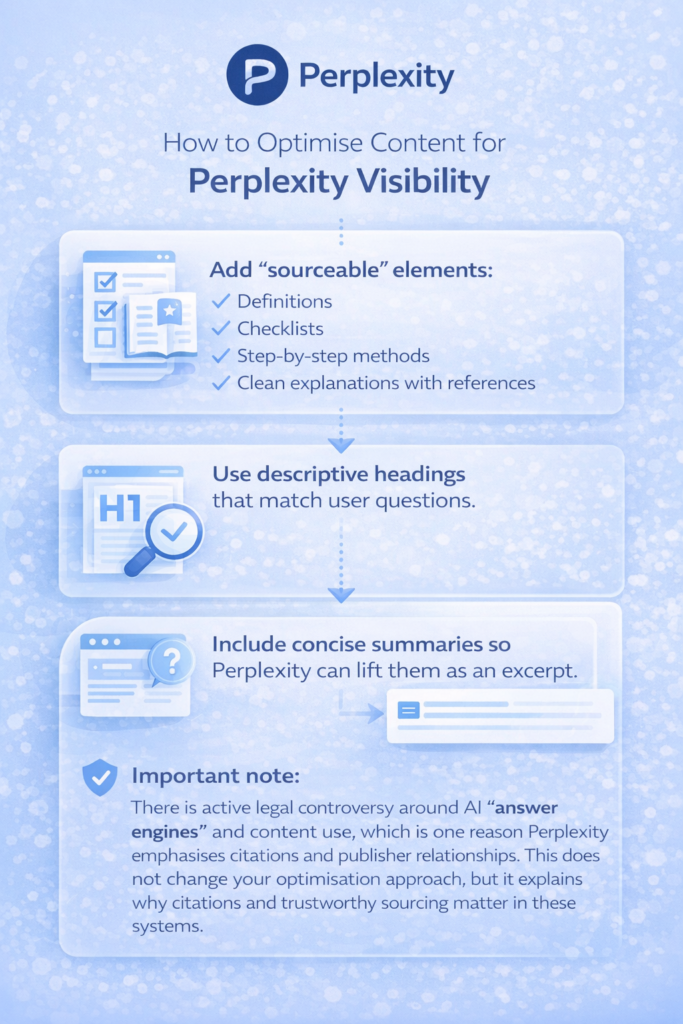
- Add “sourceable” elements:
- Definitions
- Checklists
- Step-by-step methods
- Clean explanations with references
- Use descriptive headings that match user questions.
- Include concise summaries so Perplexity can lift them as an excerpt.
Important note:
- There is active legal controversy around AI “answer engines” and content use, which is one reason Perplexity emphasises citations and publisher relationships. This does not change your optimisation approach, but it explains why citations and trustworthy sourcing matter in these systems.
9. Benefits of Strong AI Search Visibility
Visibility in AI reduces dependency on clicks alone and provides:
- Higher brand authority in direct answers.
- Better educational reach upstream of conversion funnels.
- Trust building when AI assistants recommend you.
- Improved discovery across platforms (text, voice, assistant).
Brands with strong AI search visibility gain higher perceived expertise and recall even among users who do not click a link.
10. Business Types That Benefit Most
- Roofing and construction
- HVAC and heating services
- Salons and beauty clinics
- Doctors and private healthcare
- Dentists and therapists
- Estate agents and property services
- Professional services
- E-commerce and local retail
- Law
- HR
- Software as a Service (SaaS)
- Medical
- Recruitment
- Personal trainers
- Restaurants
- Hotels
- Private car hire
- Farm shops
- Psychotherapists
- Tree surgeons
- Performing arts schools
- Nurseries
11. Platforms Shaping AI Search
- ChatGPT – conversational responses to user queries.
- Google AI Overviews – summarised results drawn from indexed pages.
- Gemini – conversational search by Google with citation emphasis.
- Copilot (Microsoft) – task-oriented answers in context.
- Perplexity – research-focused direct answer engine.
Each platform has unique retrieval behaviors; optimising across them improves omni-presence.
12. Where Your Content Must Appear
To maximise AI search visibility, your content should span:
- Blogs with defined Q&A style sections.
- Service pages with structured explanations.
- FAQs that explicitly answer common queries in natural language.
- Location pages with GEO and local markers.
Content must be multi-format and clearly structured so AI can extract it easily.
13. How Marketing Mavens Supports UK and Regional Brands for AI Search Visibility
At Marketing Mavens, we don’t just do generic SEO, we build AI-aligned visibility strategies tailored to UK and regional businesses, especially for markets like Glasgow, Edinburgh, Aberdeen and beyond. Our approach blends deep local understanding, modern AI search optimisation (AI SEO/AEO), and traditional organic ranking foundations into a cohesive system that drives both ranking and citation visibility in AI-driven search as well as SERPs.
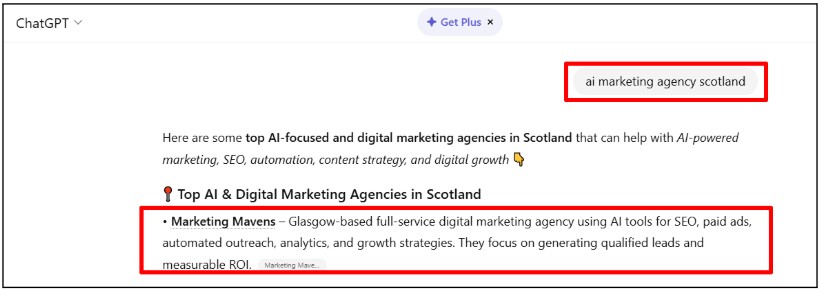
Here’s how we elevate brands to be not only discoverable but referenced by AI systems and real users alike:
13.1 Audit: Baseline AI & Local Search Presence
Before we do anything else, we measure where your brand currently stands in both traditional search and AI discovery:
Comprehensive AI & SEO Visibility Review
- We analyse your existing top-ranking keywords and find gaps where AI is not citing you.
- We check usage patterns of your core terms like “AI search visibility” and “AI SEO” within your content.
- We look at how often AI outputs mention your brand, because AI visibility is not just ranking, it’s reference frequency.
- We assess your local signals: Google Business Profile presence, directory accuracy, regional content density, and review consistency.
Why this matters:
AI systems that generate answers prefer trusted, structured, contextually precise sources — if your current content is vague, fragmented, or lacking local specificity, AI is far less likely to include your site in answers. An audit diagnoses exactly why this happens and where the opportunity lies.
This step identifies:
✔ Foundational SEO issues (titles, tags, crawlability)
✔ Content gaps relevant to AI conversational queries
✔ Local SEO weaknesses (e.g., missing service-area pages, inconsistent NAP info)
✔ Authority signals AI systems treat as trust markers
It gives us a data-backed blueprint for rapid and sustained AI visibility improvements.
13.2 Structuring AI-Friendly Content
AI search systems, including tools like Google AI, Gemini, ChatGPT, Copilot, and Perplexity, prefer content that answers questions clearly, directly, and in context. The more extractable your content is, the more likely AI is to use it in answers.
At Marketing Mavens we:
Write for clarity + AI extraction
- Use question-style headings (e.g., “What is AI search visibility?”).
- Provide direct answers immediately under the heading.
- Surround definitions with contextual explanation (why it matters, examples, local relevance).
- Use structured lists and step-by-step sections that AI can pull as snippets.
Example section structure we use:
- What the term means
- Why it matters to the user (business context)
- How to apply it locally in the UK
- A real business outcome or case illustration
This pattern aligns with how AI models rewrite and summarise content, improving your chances of being used as a referenced source rather than buried in noise.
13.3 Semantic Optimisation & AEO Best Practices
With AI becoming a primary discovery layer, we go beyond keyword stuffing. We optimise content semantically and for Answer Engine Optimisation (AEO):
We focus on:
- Natural language that mirrors how users ask questions in AI tools.
- Entity-based writing that clearly connects your brand, services, and locations.
- Topical clusters that demonstrate depth and authority around strategic themes.
- Schema markup (FAQ, Organisation, LocalBusiness, Service) that signals meaning to AI and search crawlers alike.
Semantic optimisation helps AI understand context and not just terms, so a phrase like “AI search visibility for UK businesses” isn’t just a keyword, it’s a concept AI can link to your expertise. This is crucial for both AI answers and Google’s evolving AI Overview displays.
13.4 Enhancing Local Signals & Location Pages
Local search signals are core to visibility, and AI systems increasingly bake them into their answers when queries have a geographic intent. For example:
“AI SEO services for businesses in Glasgow”
Your content should clearly signal:
📍 Where you serve
📍 What services you offer
📍 Why that place matters
Our local AI visibility strategy includes:
- Dedicated location landing pages for cities and regions.
- Content that embeds regional language, businesses in Glasgow, Scotland SMEs, UK tech companies, so AI sees geographic relevance.
- Consistent citations across directories and review sites.
- Optimised Google Business Profiles with accurate services, categories, and local keywords.
Local SEO and AI visibility overlap, because AI systems use geographic signals to decide which businesses to include in geographically anchored answers. When your site clearly communicates location + service + expertise, AI is far more likely to cite you.
13.5 Structured On-Page Signals & Technical Readiness
Technical foundations still matter, especially for AI systems that rely on structured data and machine readability.
We ensure:
- Clean HTML structure with semantic headings.
- Fast, crawlable pages that AI can parse.
- Internal linking frameworks that signal topic clusters.
- Metadata and structured data that help AI and search engines properly index and interpret content.
These aspects are invisible to users but crucial to making your content discoverable, scannable and referenceable by AI models and search crawlers alike.
13.6 Continuously Tracking AI Visibility, Mentions & Outcomes
AI visibility isn’t a one-time task, it’s dynamic. Queries change, AI systems evolve, and competition adapts.
We track:
- AI mentions: how often your brand, services, or pages are referenced in AI outputs.
- Traffic signals from both organic search and AI discovery.
- Local signals such as map views, local clicks, and reviews.
- Brand authority metrics, including citations and snippet appearances.
Our reporting translates AI signals into real business impact, showing how visibility gains connect to enquiries, leads, and revenue growth. This aligns with our results-first philosophy: not just visibility, but measurable commercial value.
14. Why Clients Choose Marketing Mavens for AI Search Visibility
As a Scotland-based digital marketing agency with local roots and national ambition, Marketing Mavens works differently than generic agencies:
- Local market expertise: We understand UK search patterns, regional buyer behaviour, and what puts local brands in front of ready-to-buy audiences.
- Full-funnel strategy: SEO, PPC, content, CRO, and AI visibility all work together, not as disconnected activities.
- Transparent performance reporting: We use clear dashboards, not vague metrics.
- Data-led customisation: Strategies are tailored to your business goals and competitive landscape.
- Free audits with real insights: Our initial audit gives actionable recommendations without strings attached.
Whether you’re a B2B firm seeking national recognition or a regional service provider looking to dominate local search and AI answer results, our methodology scales with your ambition.
15. Step-by-Step: How to Improve AI Search Visibility
15.1: Step 1: Fix Your Foundations
- Clear service pages for core offerings
- Strong About page detailing expertise
- Trust signals (testimonials, certs)
15.2: Step 2: Create AI-Friendly Content
- Use clear headings
- Provide direct answers up front
- Ensure structured sections and plain language
AI systems prefer concise, machine-digestible content.
15.3: Step 3: Build Topical Authority
- Content clusters around themes
- Internal linking to reinforce relationships
- Consistent, deep content
15.4 Step 4: Optimise for AI SEO
- Use semantic keywords
- Natural language matching user intent
- Support entity recognition with schema
15.5: Step 5: Add Local SEO Signals
- Location pages
- Local keywords targeting UK regions
- Google Business Profile optimisation
- Reviews and citations boost trust
These factors matter especially for AI assistants recommending local service businesses.
15.6: Step 6: Track AI Visibility
- Manual AI search queries
- Brand mention tracking
- Monitor traffic and lead trends
Tracking allows you to see where AI platforms reference your brand before traffic arrives.
Book an AI SEO Search Visibility Audit
Ready to get your brand cited in AI answers?
Contact Marketing Mavens for a tailored AI Search Visibility audit that boosts both SEO and AI-driven discoverability.
Conclusion
Search is no longer just about blue links and rankings. People now ask AI tools what to buy, who to trust, and how to solve problems. Those tools answer with a short list of names, ideas, and recommendations. If your brand is not part of that answer, you do not exist in that moment. AI search visibility is about making sure your business is one of the brands that gets named, explained, and trusted when those questions are asked. That means moving beyond old-style SEO alone and building content that is clear, structured, authoritative, and genuinely useful. It also means showing strong local signals so that when someone asks for help “near me” or in a specific UK city, your business is the obvious choice.
At Marketing Mavens, we build visibility that works in the real world, not just in reports. We help UK and regional brands get found in Google, but more importantly, get chosen by AI search tools that now shape buying decisions. Our approach blends strong SEO foundations with AI-friendly content, semantic optimisation, and local search strategy. The result is simple: your brand shows up more often, in more places, and in more meaningful ways. You are not just ranking. You are being referenced, trusted, and remembered. That is what modern visibility looks like, and that is what we help you build.
EXCELLENTTrustindex verifies that the original source of the review is Google. Excellent Marketing company.Posted onTrustindex verifies that the original source of the review is Google. Jodie and the team were great to work with. They understood our brief well and were responsive and receptive to ideas in the creative process. We were very happy with the logo and branding work they did with us and we'll certainly continue to work with them as our business grows.Posted onTrustindex verifies that the original source of the review is Google. Working with Marrketing Mavens was an absolute pleasure! Their team demonstrated exceptional initiative and creativity throughout the entire project, transforming a static HTML site into a fully functional and beautifully designed WordPress website for Joes Faith (joesfaith.com). Before partnering with them, our old site required several updates, but our existing developers didn’t have the capacity to make those changes. Marrketing Mavens stepped in with a solution that not only looks fantastic but is also incredibly easy to update and manage ourselves. Their keen eye for design, deep understanding of our needs, and technical expertise made the entire process seamless. We’re thrilled with the results and can now focus on what matters most without worrying about the website. I highly recommend Marrketing Mavens for anyone looking to take their web presence to the next level!Posted onTrustindex verifies that the original source of the review is Google. For a top level marketing agency in Glasgow you have to consider these guys. A marketing agency who offer good honest and transparent service with reports and great communication. It's been a pleasure working and learning with Marketing Mavens of Glasgow and I look forward to continuing our business relationship for years to come.Posted onTrustindex verifies that the original source of the review is Google. Mark and his team deliver a friendly but professional service, and are extremely knowledgeable about all aspects of marketing strategy and execution. I have found them great to work with, and they are always available at the end of the phone if you need any extra support. We are now working on a second project with them, and we are already seeing new leads coming in!Posted onTrustindex verifies that the original source of the review is Google. Thank you for helping us grow our business. Excellent service, friendly and professional. Would highly recommend.Posted onTrustindex verifies that the original source of the review is Google. Mark and the guys at Marketing Mavens have done an outstanding job on our website development - nothing has been too much trouble. Quality site and climbing well up the rankings. Top marks (no pun intended!)Posted onTrustindex verifies that the original source of the review is Google. Great marketing agency who have helped me with my digital marketing recently
Frequently Asked Questions
Book your free audit with Marketing Mavens, the agency that builds local strategies, drives leads, and delivers results.
AI search uses large language models combined with retrieval systems to generate direct answers to questions, rather than just showing a list of links. In traditional Google search, you type a query, Google ranks pages, and you choose which link to click. With AI search, the system first tries to understand what you mean in natural language, then pulls information from multiple sources, and finally writes a single, summarised answer.
The key difference is visibility. In Google-only search, success means ranking highly in a list. In AI search, success means being selected, summarised, and sometimes cited inside the answer itself. This is where AI search visibility becomes critical. If your content is not easy to extract, understand, and trust, AI systems will ignore it even if it ranks well in classic search.
People use AI tools because they save time and reduce effort. Instead of clicking through several pages, users get one clear answer. AI tools also understand conversational questions better, such as “Which marketing agency is best for small UK businesses?” rather than short keyword phrases.
Another reason is trust. When AI answers confidently and clearly, users often accept the response as a recommendation. This changes how decisions are made. For businesses, this means that AI search visibility now shapes brand perception before a user ever visits a website.
AI SEO is the process of making your content easy for AI systems to retrieve, understand, summarise, and reference. Traditional SEO focuses on rankings, backlinks, and keyword placement. AI SEO focuses on structure, clarity, intent-matching, and authority so that AI tools choose your content as part of their answer.
In traditional SEO, you optimise for search engine algorithms. In AI SEO, you optimise for understanding. That means writing in natural language, answering questions directly, structuring pages clearly, and showing real expertise. AI SEO still uses classic SEO foundations, but adds a layer focused on being chosen, not just ranked.
Search behaviour changes by location. The way people in the UK search, talk, and choose services is different from the US, Europe, or Asia. Marketing Mavens focuses on UK and regional search patterns because AI systems use location signals when deciding which businesses to include in answers.
If someone asks, “Who offers AI SEO services in Glasgow?” the system looks for strong UK signals: location pages, regional language, consistent business listings, and real local proof. Marketing Mavens builds AI search visibility around real UK markets so that local and national businesses appear when location matters.
Google Business Profile is a strong trust and location signal. Even though AI tools are not all Google-owned, many still rely on web data influenced by Google’s ecosystem. A complete and active profile shows that your business is real, local, and active.
Reviews, categories, photos, and updates all help confirm who you are and where you operate. When AI systems look for local or service-based answers, they often rely on signals that come from business listings, reviews, and citations. A weak profile makes your business harder for AI to trust.
Your business appears in AI answers when your content is easy to extract, clearly relevant, and trusted. This means:
- Clear headings and direct answers
- Pages focused on one main topic
- Natural language that matches real questions
- Strong authority signals like case studies and reviews
- Clear location and service details
AI search visibility is built by making your site understandable, useful, and reliable. If your content looks generic or confusing, AI systems will skip it.
Most websites do need changes. Many sites are built for humans and search engines, but not for AI extraction. Long paragraphs, unclear headings, mixed topics, and vague language make it hard for AI to use your content.
To support AI SEO, websites usually need clearer structure, question-based headings, direct answers, stronger service pages, better local pages, and visible trust signals. These changes also improve normal SEO, so they benefit both systems.
Ranking on Google means appearing in a list of results. Being cited by AI means being part of the answer itself. In Google search, users still choose where to click. In AI search, the system often makes that choice for them.
You can rank well and still be invisible to AI. That is the visibility gap. AI search visibility means your brand shapes the answer, not just waits to be clicked.
AI does not need generic content. It can create that itself. What it looks for is originality, experience, and clarity. Brands stand out by:
- Showing real processes
- Sharing unique insights
- Explaining how they work
- Using consistent brand voice
- Providing proof and examples
If your content sounds like everyone else, AI has no reason to prefer it. Authority, clarity, and originality make your brand worth referencing.
Marketing Mavens does not treat AI search as a trend. It treats it as a new visibility layer. Instead of chasing rankings alone, the focus is on being selected by AI systems. That means building content that is clear, structured, authoritative, and locally relevant.
Their approach combines strong SEO foundations with AI SEO, Answer Engine Optimisation, and local visibility. They track not just traffic, but mentions, citations, and influence in AI answers. The goal is simple: help UK and regional brands get found, chosen, and trusted wherever people now search, whether that is Google, ChatGPT, Gemini, Copilot, or Perplexity.

Kanwal Hafeez
SEO Specialist


